
BRAND STORY
FWAuto Engineering Blog·Firmware Workflow
Firmware development has a strange property most software has left behind: finishing the code is not the same as finishing the work.
A backend engineer who merges a passing PR is usually done. A firmware engineer who flashes a compiling driver has completed maybe half the job — the other half starts once the board doesn’t quite behave: a misconfigured clock, a silent errata, an SDK example written for a different silicon revision.
This gap between “the code compiles” and “the product works” is where firmware schedules quietly fall apart. It’s also the reason FWAuto exists.
01 The problem isn’t writing code
AI coding tools can now write a UART driver or a peripheral init sequence in seconds. For application software, that’s often close to sufficient because a passing test in a sandbox behaves the same way in production.
Firmware doesn’t work that way. Code that “looks correct” and code that “works on real silicon” are different claims. The distance between them is where firmware engineers spend most of their time, navigating tasks such as reading register maps, cross-referencing errata, flashing, reading logs, and tracing a failure three layers removed from its symptom.
None of that is a code-generation problem. It’s a workflow problem: long, sequential, and evidence-driven, ending only with a verified result on physical hardware.
02 What generic AI coding tools optimize for
General-purpose AI coding tools are optimized for a world where “the code runs” is a good proxy for “the code works” — a fast loop inside a machine that behaves identically across environments.
Firmware breaks that assumption. The same code can behave differently across board revisions or silicon steppings. The only source of truth is the physical board — not a simulator, not a unit test.

That’s not a knock on those tools. Firmware simply needed a system built around the shape of the workflow, not the shape of code generation.
03 Building around the workflow, not the model
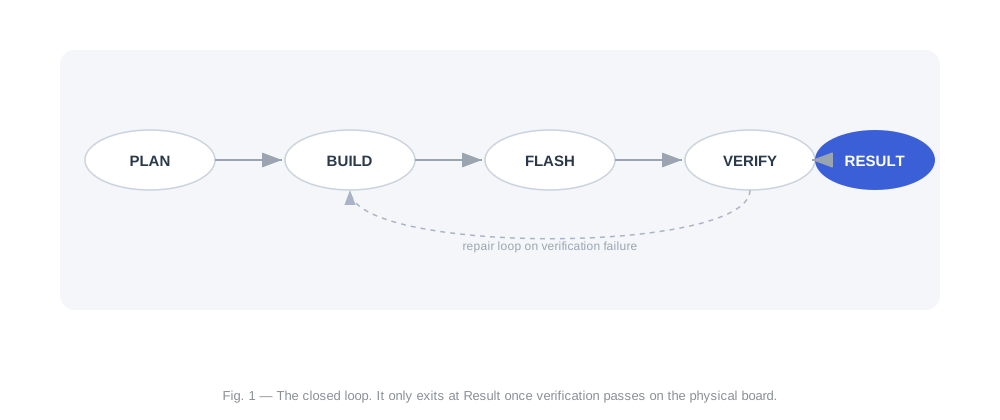
driver. It’s in reliably completing the full sequence — datasheet, implementation, build, flash, verify, repair — through to a working, verified product.
FWAuto sits on top of frontier AI models rather than competing with them on reasoning. Its job is orchestration and verification: executing each step against real toolchains and closing the loop with evidence from physical hardware.
04 Why “real hardware” is not a minor detail
It’s tempting to treat hardware verification as a nice-to-have layer on top of AI-generated code. In firmware, it’s closer to the entire point — a datasheet can describe a register incorrectly, and a build that succeeds in CI can still fail on a specific board revision.
Errata make this concrete: chip vendors publish them precisely because documented and actual silicon behavior sometimes diverge — a detail easy to miss inside a thousand-page reference manual under deadline pressure.
That’s why “the code compiles” was never a meaningful finish line here. The loop has to end on the board, because that’s the only place the ground truth lives.
05 What this looks like in practice
The workflow FWAuto automates isn’t abstract — it’s the same sequence experienced engineers already follow, compressed and run without manual handoffs: research, implement, build, flash, verify, and when something fails, diagnose and repair without a human re-entering the loop each time.
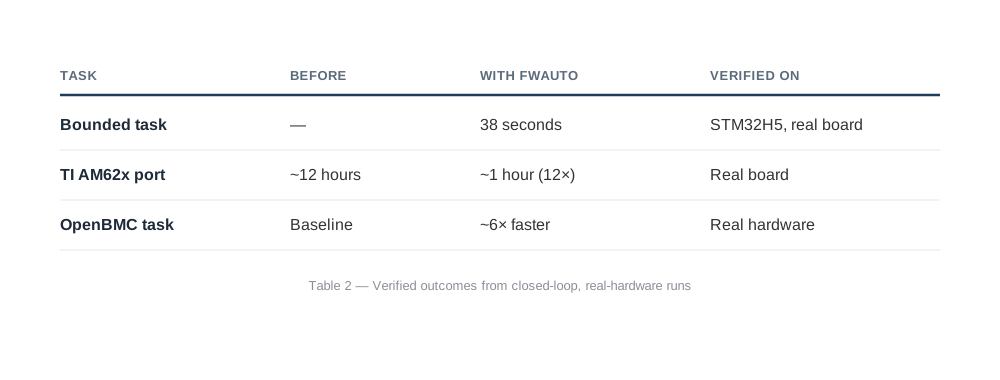
The point isn’t that FWAuto generates code faster. It’s what happens once the unit of work shifts from “a code suggestion” to “a verified result.”
06 A different way to think about where AI fits
Language models reason and generate in text, but they don’t touch physical hardware. Someone — or something — still has to turn that reasoning into build commands, flashing sequences, and log interpretation on a real board. As models get better at reasoning, the bottleneck shifts to whatever executes and verifies that reasoning in the physical world.
That’s the layer FWAuto is built for — not a competitor to the models, but the execution and verification layer that connects them to real silicon.
This doesn’t make writing firmware code unimportant — it’s the opposite. Code generation has gotten fast enough industry-wide that it’s no longer the differentiator. What separates a working product from a demo is whether the full workflow actually completes, with evidence at every step.
That’s the bet behind FWAuto, and it’s why it exists.